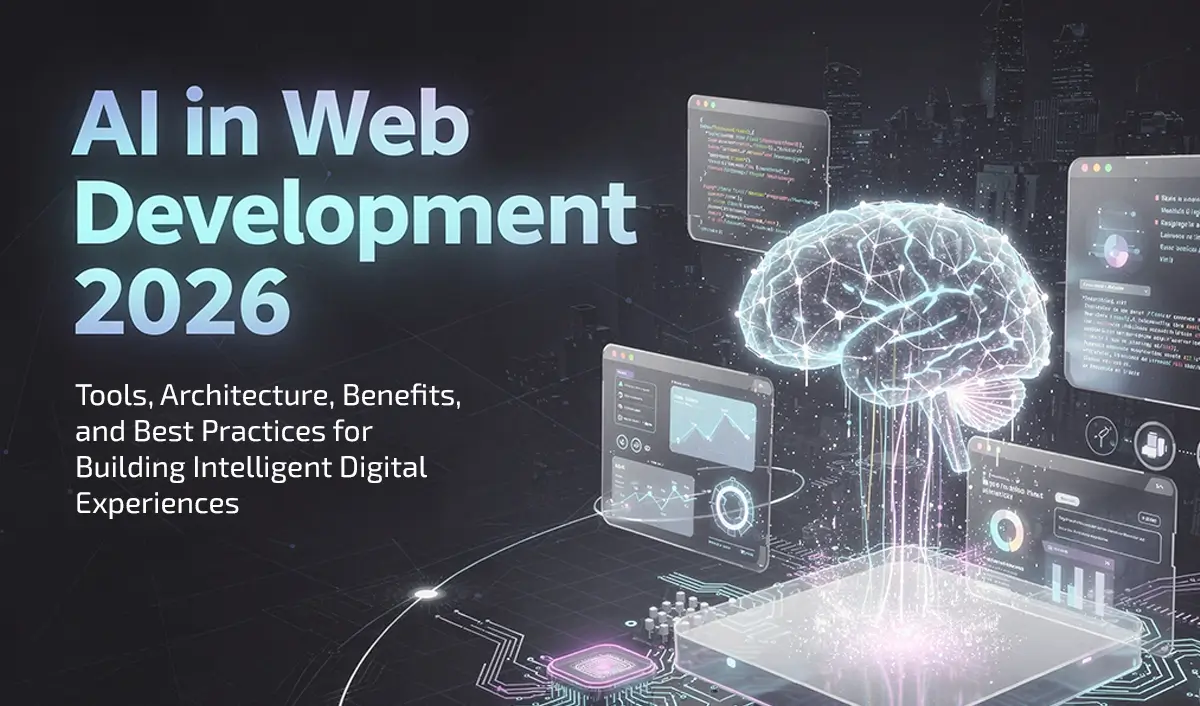

AI in Web Development 2026: Tools, Architecture, Benefits, and Best Practices for Building Intelligent Digital Experiences
Artificial Intelligence (AI) has moved beyond experimental technology and into the core of modern web development. In 2026, nearly every high-performing web application relies on AI in some capacity—whether for personalization, automation, predictive analytics, security, or customer interaction. Websites are no longer static systems built once and maintained periodically. They are living digital platforms that learn from users, adapt their behavior, and improve continuously.
This transformation affects every layer of development, from frontend design to backend infrastructure, from deployment pipelines to user experience strategies. AI is not replacing web developers. Instead, it is reshaping their role, turning developers into system designers, AI supervisors, and experienced architects.
The goal of this guide is to explain how AI is changing web development, what tools and technologies matter most, how businesses can adopt AI responsibly, and what best practices ensure long-term scalability, performance, and trust.
Why AI Matters for Web Development
The internet has always evolved quickly, but AI accelerates that evolution exponentially. Traditional websites followed predictable rules: content was displayed based on predefined logic, and user journeys were largely static. Modern websites powered by AI respond dynamically to user behavior, preferences, and intent.
AI matters because it introduces intelligence into digital systems. Instead of simply responding to requests, websites can now anticipate needs, recommend actions, and optimize themselves automatically.
Key reasons AI is essential in web development:
Complexity management
Modern applications handle massive data volumes and user interactions. AI helps interpret and act on that data.
Speed of delivery
AI-assisted development shortens build cycles from weeks to days.
User expectations
Users now expect personalization, instant responses, and predictive behavior.
Security demands
AI identifies threats faster than traditional rule-based systems.
Competitive pressure
Businesses using AI innovate faster and adapt more efficiently.
What Are AI Web Development Tools?
AI web development tools are software platforms that apply machine learning, natural language processing, and neural networks to automate or enhance development tasks. These tools interact with developers using natural language or contextual analysis rather than rigid commands.
Instead of manually coding everything, developers can:
- Describe functionality in plain English.
- Let AI generate structured code.
- Validate and optimize the output.
- Iterate faster with intelligent suggestions.
AI tools assist with:
- Code generation and refactoring
- Debugging and testing
- UX optimization
- Content generation
- Analytics interpretation
- Security auditing
This shifts development from line-by-line programming to higher-level orchestration and validation.
The Evolution from Traditional to AI-Enhanced Web Development
Traditional Web Development
Traditional development depends on:
- Hard-coded logic
- Manual testing
- Fixed UI/UX flows
- Rule-based security
- Reactive maintenance
This model is predictable but slow and rigid. Changes require manual updates, and systems struggle to adapt to user behavior patterns.
AI-Enhanced Web Development
AI-enhanced development introduces:
- Learning algorithms
- Automated testing
- Behavior-driven UI
- Predictive analytics
- Autonomous optimization
Instead of coding for every scenario, developers train systems to learn patterns and improve over time. This enables:
- Real-time personalization
- Faster error detection
- Automated performance tuning
- Intelligent content delivery
AI-enhanced systems grow more accurate as they collect more data.
Core Benefits of AI in Web Development
1. Speed and Productivity
AI reduces development time by :
- Generating boilerplate code
- Suggesting functions and logic
- Automating repetitive tasks
- Running automated tests
This allows teams to focus on :
- System architecture
- Business logic
- UX strategy
2. Cost Efficiency
AI lowers :
- Development hours
- Maintenance overhead
- Testing resources
- Support workload
Automated chatbots and analytics reduce operational costs while improving service.
3. Scalability
AI-driven architectures adapt to :
- Traffic spikes
- Behavioral changes
- Data growth
- Feature expansion
Scalable AI systems prevent bottlenecks and ensure consistent performance.
4. Personalization
AI customizes :
- Traffic spikes
- Behavioral changes
- Data growth
- Feature expansion
This increases:
- Engagement
- Retention
- Conversion rates
5. Security and Compliance
AI :
- Detects vulnerabilities
- Flags anomalies
- Predicts attack patterns
- Automates compliance checks
Security shifts from reactive to predictive.
Challenges and Risks of AI Adoption
1. Data Dependency
- AI is only as good as its data. Poor data leads to biased or inaccurate outputs.
2. Overreliance
Blind trust in AI-generated code can:
- Introduce hidden bugs
- Create security risks
- Break business logic
3. Privacy and Regulation
AI systems process large amounts of user data, requiring compliance with:
- GDPR
- CCPA
- HIPAA
- AI governance frameworks
4. Integration Complexity
AI tools must integrate with:
- Existing frameworks
- CMS platforms
- CI/CD pipelines
- Databases
Poor integration creates friction instead of efficiency.
Factors to Consider When Choosing AI Web Development Tools
Frequently Asked Questions
No. AI automates repetitive tasks, but strategy, creativity, and system design still require human expertise.
Speed combined with intelligence. AI shortens development cycles while improving personalization and reliability.
Yes, but production systems still require human validation and refinement.
They can be secure if AI security tools and human review are used together.
Yes, especially for rapid prototyping and automation.
Through personalization, predictive navigation, and intelligent interfaces.
Scalable hosting, fast storage, real-time processing, and secure data handling.
GitHub Copilot and ChatGPT-based coding tools.
AI-first architectures with human-led design and governance