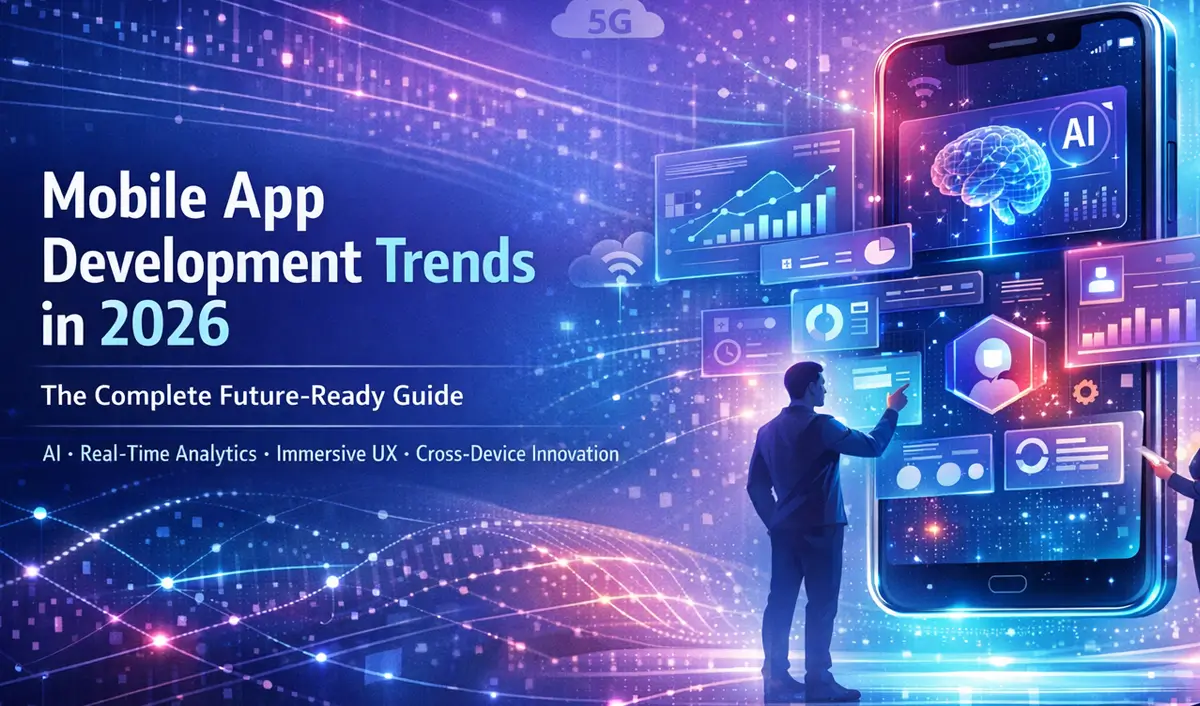
Mobile App Development Trends in 2026: The Complete Future-Ready Guide
The global mobile market is projected to grow fivefold by 2030, according to Statista. But with millions of apps already flooding app stores, the real challenge is not building an app — it is building one that stands out.
In an overpopulated ecosystem, differentiation comes from intelligence, personalization, speed, and immersive utility. Traditional feature-heavy apps are being replaced by smarter, adaptive, and predictive systems powered by Generative AI, advanced networks, and real-time analytics.
By 2026, mobile app success will no longer be measured by downloads alone. Retention, predictive behavior, seamless experiences, and cross-device functionality will define winning products.
This comprehensive guide explores the top mobile app development trends of 2026, how they impact businesses, and how organizations can prepare to build future-ready applications.
Mobile App Development Landscape in 2026
Companies are no longer asking, “Do we need an app?”
They are asking, “How smart, secure, and scalable should our app be?”
Key transformations shaping 2026
- Manual workflows → AI-driven automation
- Generic experiences → Hyper-personalized journeys
- Basic security → Privacy-first development
- Single-device apps → Cloud-native multi-device ecosystems
Generative AI and Hyper-Personalization
AI has moved beyond chatbots. By 2026, Generative AI will power:
- Content creation
- Real-time user intent prediction
- Adaptive user interfaces
- Automated coding and workflows
The generative AI market is expected to reach $55.5 billion in 2026 and over $1 trillion by 2034. Users will expect apps to write emails, generate itineraries, provide instant customer service, and build documents automatically.
Hyper-personalization means interfaces will dynamically change based on:
- User behavior
- Location
- Preferences
- Usage patterns
Apps without AI-driven intelligence will struggle to compete.
Example: AI assistants like Gemini act as conversational engines that replace traditional mobile search.
6G Readiness and Ultra-Fast Infrastructure
- Holographic communication
- Real-time extended reality
- Cloud-rendered simulations
- Zero-latency applications
- Education
- Healthcare
- Gaming
- Engineering
- Remote collaboration
Augmented Reality (AR) and Virtual Reality (VR)
- Retail
- Manufacturing
- Healthcare
- Gaming
- Education
By 2035, the AR/VR market is projected to approach $1.98 trillion. Cloud streaming will allow mobile VR experiences without heavy device processing.
Use cases include:
- Virtual try-ons
- Product visualization
- Immersive training
- Spatial storytelling
Example: IKEA Kreativ allows users to scan their room, remove existing furniture using AI, and place 3D models in real space.
AIoT-Powered Intelligent Ecosystems
- Smart homes
- Wearables
- Vehicles
- Appliances
- Industrial systems
The AIoT market is expected to reach $81.04 billion by 2031.
- Lighting
- Temperature
- Energy usage
- Health monitoring
Example: Samsung SmartThings uses AI to optimize energy consumption based on user habits.
Blockchain Decentralization and Security
- Identity verification
- Data protection
- Financial transactions
- Healthcare records
Example: World App uses World ID to verify human identity without revealing personal details.
Progressive Web Apps (PWAs)
PWAs provide app-like experiences without app store downloads. The PWA market is expected to reach $7.6 million by 2026.
Benefits include:
- Faster time-to-market
- Lower development costs
- Offline access
- Instant updates
- Low storage usage
Example: Starbucks PWA allows menu browsing and ordering even offline.
Voice and Conversational Interfaces
The voice recognition market is projected to exceed $123 billion by 2034.
By 2026, “Zero UI” will dominate:
- Voice navigation
- Speech commands
- Conversational AI
This reduces screen fatigue and enhances accessibility for:
- Navigation
- Smart homes
- Healthcare
- Customer service
Domination of Mobile Commerce (m-Commerce)
Global mobile commerce is expected to reach $2.4 trillion in 2026.
Key trends include:
- Live-stream shopping
- Social commerce
- One-tap checkout
- AI-driven recommendations
Apps like Whatnot allow live auctions and instant purchases.
Benefits:
- Lower cart abandonment
- Higher impulse buying
- Better personalization
Foldable Device Optimization
Apps must adapt to:
- Multiple screen states
- Split-screen continuity
- Dual experiences
Design will include:
- Cover-screen quick actions
- Inner-screen productivity
Low-Code and No-Code Development
- Rapid MVP development
- Lower costs
- Faster innovation
This allows:
- Marketing teams to build tools
- Developers to focus on complex systems
- Businesses to validate ideas quickly
Cloud-Native Mobile Applications
- Microservices
- Containers
- Server less systems
This allows:
- Marketing teams to build tools
- Developers to focus on complex systems
- Businesses to validate ideas quickly
Benefits:
- Scalability
- High performance
- Lower costs
- Traffic spike handling