techccontdetaics Web Technologies February 24, 2026 177 7 minutes read

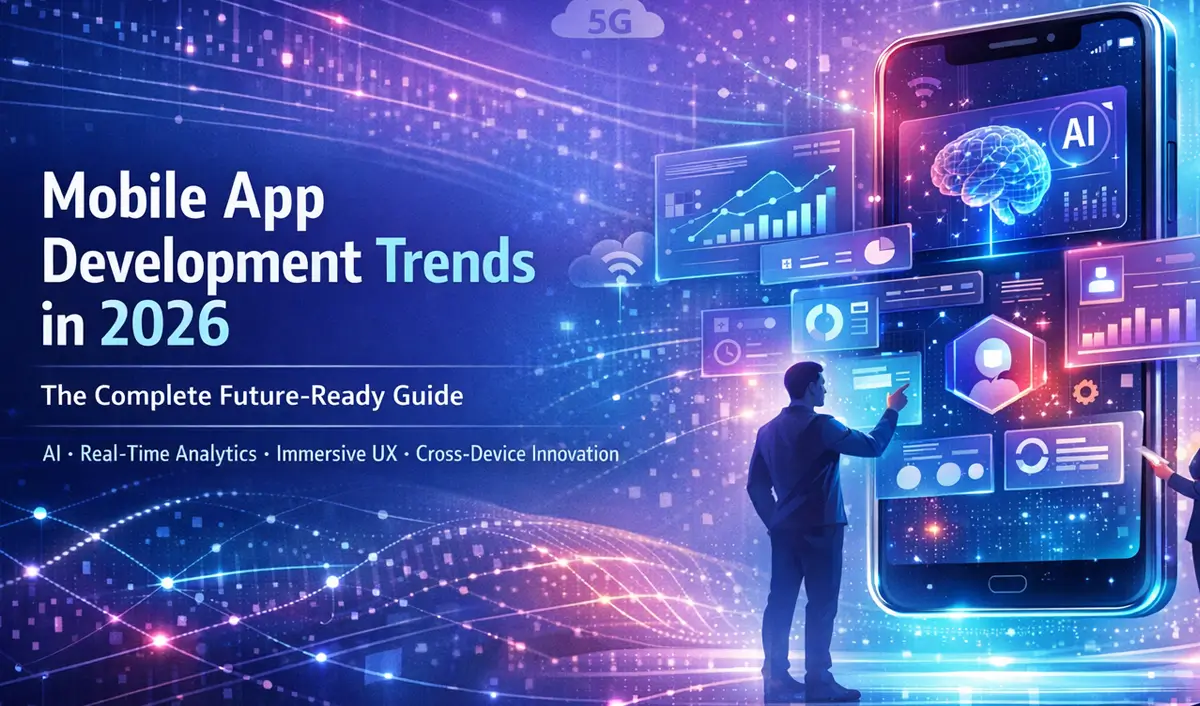
Mobile App Development Trends in 2026: The Complete Future-Ready Guide

The global mobile market is projected to grow fivefold by 2030, according to Statista. But with millions of apps already flooding app stores, the real challenge is not building an app — it is building one that stands out.

In an overpopulated ecosystem, differentiation comes from intelligence, personalization, speed, and immersive utility. Traditional feature-heavy apps are being replaced by smarter, adaptive, and predictive systems powered by Generative AI, advanced networks, and real-time analytics.

By 2026, mobile app success will no longer be measured by downloads alone. Retention, predictive behavior, seamless experiences, and cross-device functionality will define winning products.
This comprehensive guide explores the top mobile app development trends of 2026, how they impact businesses, and how organizations can prepare to build future-ready applications.

Mobile App Development Landscape in 2026

Companies are no longer asking, “Do we need an app?”
They are asking, “How smart, secure, and scalable should our app be?”

Key transformations shaping 2026

This shift affects industries such as finance, healthcare, education, retail, logistics, and enterprise software.

Generative AI and Hyper-Personalization

AI has moved beyond chatbots. By 2026, Generative AI will power:

The generative AI market is expected to reach $55.5 billion in 2026 and over $1 trillion by 2034. Users will expect apps to write emails, generate itineraries, provide instant customer service, and build documents automatically.

Hyper-personalization means interfaces will dynamically change based on:

Apps without AI-driven intelligence will struggle to compete.

Example: AI assistants like Gemini act as conversational engines that replace traditional mobile search.

6G Readiness and Ultra-Fast Infrastructure

As 6G networks begin emerging, they will enable:
The 6G market is projected to reach $110.46 billion. Developers will offload processing to the cloud, reducing app size while increasing performance.
This allows mid-range smartphones to run high-end simulations and immersive platforms, opening new possibilities for:

Augmented Reality (AR) and Virtual Reality (VR)

AR and VR are becoming essential engagement tools in:

By 2035, the AR/VR market is projected to approach $1.98 trillion. Cloud streaming will allow mobile VR experiences without heavy device processing.

Use cases include:

Example: IKEA Kreativ allows users to scan their room, remove existing furniture using AI, and place 3D models in real space.

AIoT-Powered Intelligent Ecosystems

Mobile apps are becoming command centers for connected devices. AIoT (Artificial Intelligence of Things) integrates AI with:

The AIoT market is expected to reach $81.04 billion by 2031.

Mobile apps will automatically adjust:

Example: Samsung SmartThings uses AI to optimize energy consumption based on user habits.

Blockchain Decentralization and Security

Blockchain will play a critical role in:
The blockchain market is projected to exceed $393 billion by 2030.
With stricter privacy regulations like GDPR and CCPA, decentralized identity apps will allow users to control their personal data.

Example: World App uses World ID to verify human identity without revealing personal details.

Progressive Web Apps (PWAs)

PWAs provide app-like experiences without app store downloads. The PWA market is expected to reach $7.6 million by 2026.

Benefits include:

Example: Starbucks PWA allows menu browsing and ordering even offline.

Voice and Conversational Interfaces

The voice recognition market is projected to exceed $123 billion by 2034.

By 2026, “Zero UI” will dominate:

This reduces screen fatigue and enhances accessibility for:

Domination of Mobile Commerce (m-Commerce)

Global mobile commerce is expected to reach $2.4 trillion in 2026.

Key trends include:

Apps like Whatnot allow live auctions and instant purchases.

Benefits:

Foldable Device Optimization

Foldable Smartphone shipments are growing by over 50% annually.

Apps must adapt to:

Design will include:

Low-Code and No-Code Development

Low-code tools enable:

This allows:

Cloud-Native Mobile Applications

Cloud-native architectures using:

This allows:

The cloud-native market will reach $57.69 billion by 2026.

Benefits:

Predictive Analytics and Big Data

The predictive analytics market is expected to reach $28.1 billion by 2026.

Apps will proactively:

Example: Cleo predicts overdrafts and savings opportunities.

mHealth and Telemedicine

mHealth apps will exceed $154 billion by 2034.

Trends include

Benefits

DevSecOps and Security-First Development

Security is embedded into development pipelines.
The app security market will reach $15.62 billion in 2026.

Includes

Security builds trust and reduces breach risk.

Brain-Computer Interfaces (BCI)

BCI allows control via brain signals.

Market growth: 14.1% CAGR (2024–2029)

Future capabilities

Future capabilities

Common Mistakes to Avoid in 2026

Strategy must guide technology adoption.

How to Prepare for Mobile App Development in 2026

Opportunities for Developers and Businesses

Developers

Businesses


Conclusion

Mobile app development in 2026 will be defined by:

  • AI-driven intelligence
  • Immersive experiences
  • Privacy-first design
  • Multi-device ecosystems

Apps that adapt early will dominate. The future belongs to businesses that blend technology with user-centric design.

FAQs

Frequently Asked Questions

Generative AI and hyper-personalization are the most impactful trends, transforming how apps interact with users.

PWAs will complement native apps, especially for startups and e-commerce, but high-performance apps will still need native development.

No. Blockchain is essential for finance, healthcare, and identity-based apps but not required for all applications.

They enable ultra-fast, immersive experiences like AR/VR, cloud gaming, and real-time collaboration.

Yes. Apps must adapt to variable screen sizes and continuity to remain usable across modern devices.

Healthcare, finance, retail, logistics, and education see the highest impact.

On-device AI improves speed and privacy, while cloud AI handles heavy processing. Most apps will use both.

It integrates security into every development stage instead of adding it later.

Not fully, but voice interaction will become a primary interface for many tasks.

Audit current apps, identify gaps, adopt scalable architecture, and integrate AI strategically.

Share: