
techccontdetaics AI February 27, 2026 669 7 minutes read

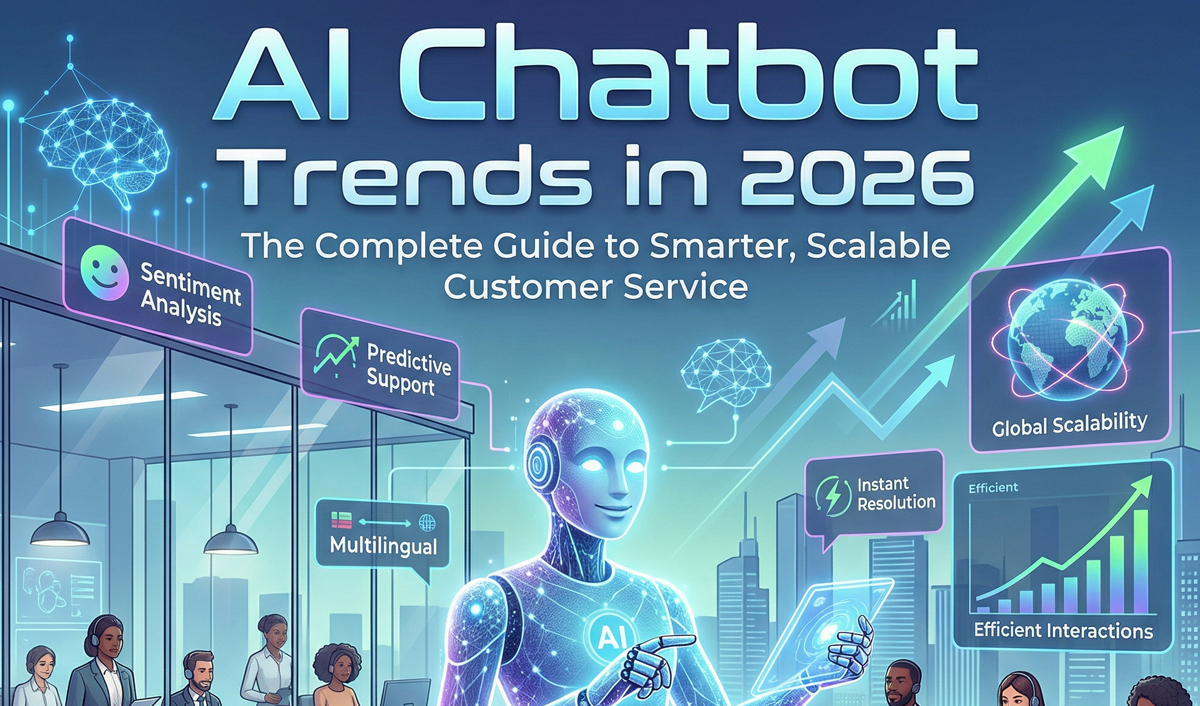
AI Chatbot Trends in 2026: The Complete Guide to Smarter, Scalable Customer Service

The AI chatbot landscape is undergoing one of the fastest transformations in the history of digital technology. What worked in 2024 will feel outdated by 2026. Scripted bots that merely respond to predefined commands are being replaced by autonomous, intelligent, and deeply integrated AI systems.

By 2026, chatbots will no longer be simple support tools. They will function as intelligent interface layers across business systems, decision-support assistants for employees, and revenue-generating customer engagement channels.

This guide explores the key AI chatbot trends shaping 2026, market projections, architectural shifts, and best practices businesses must follow to stay competitive.

Market Overview: AI Chatbots in 2026

Global adoption of AI chatbots is accelerating rapidly due to improvements in large language models, declining implementation costs, and rising customer expectations for instant service.

2026 market projections

The growth is driven by three forces

The Shift from Automation to Intelligence

Earlier chatbots focused on ticket deflection and scripted replies. In 2026, chatbots are positioned as:

This marks the transition from automation-first chatbots to intelligence-driven AI systems.

Trend 1: Agentic AI and Autonomous Chatbots

The most important trend in 2026 is the rise of agentic AI. These systems do not just respond to prompts; they reason, act, and learn.

What agentic AI enables

Autonomous problem solving such as processing refunds, modifying orders, and booking appointments

Multi-step workflows spanning CRM, payment systems, and logistics platforms

Continuous learning from outcomes and feedback

Proactive customer engagement before users ask

By 2026, businesses using agentic AI will resolve over 85% of inquiries autonomously, compared to 30–40% with traditional bots.

In hybrid architectures, chatbots act as the interaction layer, while AI agents execute backend reasoning and actions. This separation clarifies the distinction between chatbots (interface) and agents (execution engine).

Trend 2: Multimodal Interactions as Standard

Text-only bots are becoming insufficient. In 2026, AI chatbots process and respond to:

Text

Voice

Images

Documents

Structured business data

This enables

Visual product damage assessment

Voice-based enterprise assistants

Document analysis and verification

Video tutorials and guided demonstrations

Multimodal interactions improve resolution rates by 30–40% because customers can communicate naturally instead of struggling with text descriptions.

Trend 3: Context-Aware and Memory-Driven Conversations

AI chatbots are moving from stateless interactions to memory-based conversations.

This is enabled by

Vector databases for long-term memory

Optimized context windows

User journey modeling

Benefits include

Reduced repetition for users

Predictive responses

Personalized continuity across sessions

Better intent recognition

Chatbots will remember previous issues, preferences, and conversation history, allowing experiences to feel human-like and coherent.

Trend 4: Hyper-Personalization

Generic responses will fail in 2026. Chatbots will personalize interactions using:

Impact of personalization

MetricGeneric BotPersonalized AI
Engagement15–20%55–60%
Customer Satisfaction65%88%
Conversion2–3%5–7%
Repeat Usage25%60%

Personalization also extends to brand voice, ensuring tone consistency across interactions.

Trend 5: Predictive and Proactive Support

Support is shifting from reactive to predictive.

AI chatbots will

Business impact

This makes chatbots proactive experience managers rather than passive responders.

Trend 6: Voice-First Interfaces

Voice interaction is becoming mainstream.

Key adoption statistics

Modern systems allow seamless switching between voice and text mid-conversation.

Trend 7: Deep Enterprise Integration

Standalone bots are being replaced by integrated AI platforms.

Core integrations include

CRM systems

Helpdesk platforms

Payment processors

Calendar tools

E-commerce systems

Communication tools

This allows bots to take real actions rather than only provide information.

Trend 8: Enterprise-Grade Security and Compliance

Compliance-first architectures are becoming standard due to:

GDPR and global data laws

AI data leakage risks

Industry regulations

Security features include

Role-based access

Audit logging

Data isolation

Jurisdiction-aware processing

Failure to adopt secure architectures creates legal and operational risks.

Trend 9: Domain-Specific AI Chatbots

Generic models are being replaced by industry-trained bots in:

Finance

Healthcare

Legal

Manufacturing

Benefits

Higher accuracy

Reduced hallucinations

Contextual relevance

Custom AI development is now preferred over off-the-shelf tools.

Trend 10: Low-Latency and Edge-Deployed Chatbots

To improve speed and sovereignty:

This is critical for regulated industries.

Best Practices for Chatbot Success in 2026

Choose an Intelligent, Integrated Platform

Select platforms that support:

Define a Clear Purpose

Avoid building overly broad bots

Best approach:

Implement Retrieval-Augmented Generation (RAG)

RAG ensures accuracy by:

Enable Seamless Human Handoff

Essential features:

Personalize the Experience

Use:

Continuously Analyze and Optimize

Track:

Improve via:

What Businesses Must Evaluate Before Investment

Key factors:

Integration compatibility

Scalability

Governance and monitoring

Model retraining flexibility

Total cost of ownership

Without these, chatbot ROI stagnates.

Role of AI Consulting Companies

AI consulting firms support:

Architecture design

Compliance engineering

System orchestration

Scalable deployment

They help businesses avoid technical debt and security failures.

Conclusion

AI chatbots in 2026 represent a structural shift in customer engagement.

Key capabilities defining leadership:

The businesses that succeed will not be early adopters for novelty’s sake, but strategic adopters building long-term capability.

The future of customer experience is intelligent, autonomous, and proactive.

Frequently Asked Questions (FAQs)

Agentic AI is the biggest shift, allowing chatbots to reason, act, and solve problems autonomously.

They allow users to communicate using text, voice, images, and documents, improving accuracy and resolution rates.

It reduces inbound tickets, improves retention, and increases upsell opportunities by acting before issues arise.

Yes. Domain-specific chatbots provide higher accuracy and lower hallucination rates.

Retrieval-Augmented Generation allows bots to pull answers from trusted knowledge sources, improving reliability.

Voice will complement text, not replace it entirely. Users will choose based on context.

Audit current bots, integrate systems, consolidate knowledge bases, and adopt agentic platforms.

Data isolation, role-based access, audit logs, and compliance-aware data handling.

No. They handle volume while humans manage complex and emotional interactions.

Finance, healthcare, retail, SaaS, logistics, and professional services.

Share: