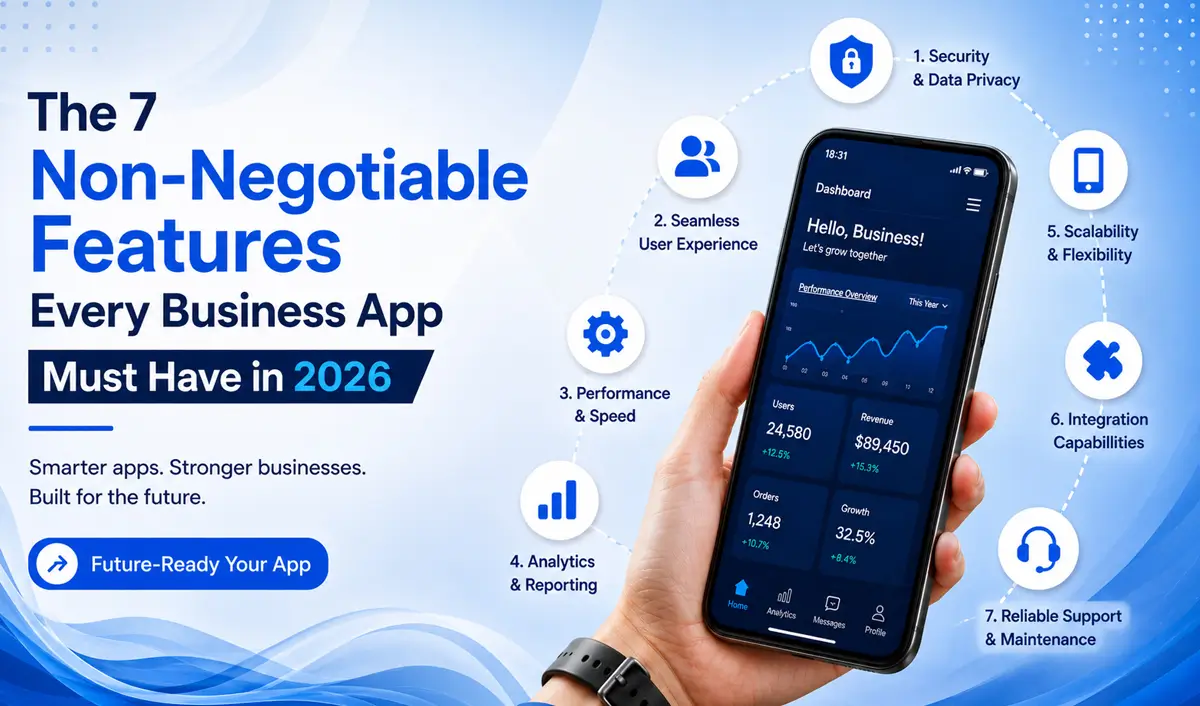
The 7 Non-Negotiable Features Every Business App Must Have in 2026
- Introduction: The Era of the Intelligent Interface
- Agentic AI & Predictive Workflows (Autonomous Actions)
- Hyper-Personalization Engines (The “Contextual UI”)
- Zero-Trust Security with (Passkey Biometrics)
- Offline-First Architecture (Edge Computing)
- Voice-First & (Conversational UI)
- Sustainable Code (Green Coding & ( Low Battery Impact))
- Interoperability via ( API-First & Web3 Elements)
- The Cost of Missing ( These Features )
- Build for the Future with ( Tech C Mantix Technologies )
Introduction: The Era of the Intelligent Interface
We are no longer in the mobile-first or cloud-first era. We are living in the era of the Intelligent Interface.
By 2026, the question for business leaders is no longer “Does my business need a mobile or web application?” The question is: “Why isn’t my current app smart enough to act on my behalf?”
The shelf-life of software features has collapsed. What was celebrated as “cutting-edge” in 2024 is now table stakes. What is considered standard in 2025 will be obsolete by Q3 2026. User behavior has shifted decisively toward three demands: hyper-personalization, predictive assistance, and ironclad security.
If you are planning to build, rebuild, or scale a business application this year, you cannot afford to simply follow trends. You must anticipate what users will expect before they know they expect it.
Below are the 7 non-negotiable features every business app must have not just to compete, but to survive and thrive in 2026.
Agentic AI & Predictive Workflows (Autonomous Actions)
What it is:
Generative AI (chatbots that answer questions) is already fading into the background. The new standard is Agentic AI—applications that don’t just respond, but take autonomous action on your behalf.
Your business app must evolve from a passive database into an active participant in your workflow.
Concrete example:
Imagine a logistics app. Instead of simply showing a driver that a shipment might be delayed, the app:
- Predicts the delay before weather patterns even shift (using historical and real-time data).
- Automatically reroutes the driver to an alternative path.
- Notifies the warehouse to adjust loading times.
- Emails the client with a new ETA—all without a single human click.
Why it matters in 2026:
Users no longer want to “navigate” an app. They want the app to remove friction entirely. If your software doesn’t predict the user’s next three moves, it feels broken. In a business context, every second spent searching, clicking, or waiting for a decision is a measurable loss in productivity.
Potential pushback: “Won’t users feel like they’re losing control?”
Yes, which is why Agentic AI must be transparent and reversible. The best implementations show a short audit trail: “I rerouted your driver because of rain. Click to undo.” Autonomy, not opacity.
Hyper-Personalization Engines (The “Contextual UI”)
What it is:
The era of one-size-fits-all dashboards is over. By 2026, a single business app will look radically different for every user—tailored to their role, location, time of day, device type, and even biometric cues.
This goes far beyond “dark mode” or remembering a user’s name. This is Dynamic UI.
Concrete example:
A junior sales development representative opens your CRM app and sees only two buttons: “Log Call” and “Add Lead.” The CFO of the same company opens the exact same app and sees a full analytics suite, cash-flow projections, and team performance metrics. A field technician in a noisy warehouse sees large, glove-friendly touch targets and voice input—while the same app on a desktop shows keyboard shortcuts.
The app even learns muscle memory: if you always tap “Expenses” at 5 PM, the app moves that button closer to your thumb by 4:55 PM.
Why it matters in 2026:
Cognitive load is the single greatest enemy of productivity. If your app requires a tutorial, onboarding video, or FAQ to explain where features are, it has already failed the 2026 standard. Users expect the app to adapt to them, not the other way around.
Real-world analogy:
Think of a luxury car that adjusts mirrors, seat position, and climate control the moment you sit down. Your app should do the same—without being asked.
Zero-Trust Security with (Passkey Biometrics)
What it is:
Passwords are officially dead. By 2026, any app still relying on SMS-based two-factor authentication (2FA) will be considered a negligent security liability.
The new baseline is Passkey authentication (FaceID, fingerprint, or device-bound biometrics) combined with Continuous Authentication—which means the app monitors how you interact with it (typing rhythm, mouse movement, phone tilt) and re-verifies you silently in the background.
Additionally, Zero-Trust Architecture (ZTA) is no longer optional. The app never trusts the internal network. Every single access request is verified as if it came from an unsecured public WiFi hotspot.
Concrete example:
You log into your company’s expense app using FaceID. Fifteen minutes later, someone else picks up your unlocked phone (perhaps you stepped away). The app detects that the typing cadence doesn’t match your profile and automatically locks the session. It doesn’t ask for a password again—it asks for your passkey or biometric re-auth.
Why it matters in 2026:
Deepfake voice phishing and AI-generated credential theft are rampant. Static passwords—even complex ones—are now a lawsuit waiting to happen. Regulators and business insurers are beginning to demand Zero-Trust as a condition for cyber liability coverage.
Data point:
According to the 2025 Verizon Data Breach Investigations Report, over 80% of hacking-related breaches involve stolen or weak passwords. Passkeys eliminate that entire vector.
Offline-First Architecture (Edge Computing)
What it is:
5G coverage is widespread, but dead zones, elevators, subways, and rural areas still exist. In 2026, a “No Internet” error message is a complete user experience disaster.
The winning feature is Offline-First design—where the app stores data locally on the device, allows full CRUD operations (Create, Read, Update, Delete) without any signal, and then syncs intelligently to the cloud once connectivity returns. This is powered by Edge Computing, meaning data processing happens on the device itself, not just on a remote server.
Concrete example:
A sales representative visits a client in a basement office with zero Wi-Fi. They can:
- Create a new quote
- Add line items
- Attach a photo of the signed contract.
- Update the deal stage.
All of this happens instantly on their iPad. When they walk up to street level and regain signal, the app syncs silently in the background—without duplicates or conflicts.
Why it matters in 2026:
Field workers, healthcare professionals, warehouse staff, and remote employees expect industrial-grade reliability regardless of network status. If your app fails offline, you are telling your most critical users: “Your work is less important than my cloud dependency.”
Technical note:
Offline-First is not the same as “caching.” Caching assumes you have connectivity at some point. Offline-First assumes connectivity is optional. The entire data model is built around local-first synchronization.
Voice-First & (Conversational UI)
What it is:
Typing on a mobile keyboard for business data entry is inefficient and error-prone. By 2026, the greenfield feature is Voice-First interfaces—but not simple voice commands like “Hey Siri, set a reminder.”
We are talking about Domain-Specific Voice Models that understand industry jargon, context, and complex queries.
Concrete example:
A medical app that accurately transcribes “Administer 5 mg of metoprolol tartrate IV push” without being trained on general-purpose speech.
A warehouse app where a worker says, “Log 12 units of SKU 440-B into bin A7,” and the system confirms instantly.
A sales app where a manager asks, “Show me the deals from last Thursday that John missed,” and the app executes the query, filters results, and highlights the reasons for missed opportunities—all by voice.
Why it matters in 2026:
Speed of input defines productivity. Voice is roughly 3x faster than typing on a mobile keyboard. More importantly, voice reduces friction in contexts where hands or eyes are busy: driving, carrying equipment, walking through a factory floor.
Potential pushback: “What about noisy environments?”
Modern domain-specific voice models include advanced noise cancellation and can be trained on the specific acoustic profile of your workplace (e.g., a warehouse floor or emergency room). The app can also fall back to a “tap-to-confirm” pattern after voice input.
Sustainable Code (Green Coding & ( Low Battery Impact))
What it is:
ESG (Environmental, Social, Governance) is no longer just a marketing slide—it is a technical requirement. Major app stores (Apple, Google, and emerging EU regulators) have begun flagging apps that drain batteries or over-utilize CPU cycles as “energy inefficient.”
In 2026, business apps must practice Green Coding—optimizing algorithms, reducing background processes, and minimizing energy consumption.
Concrete practices include:
- Reducing background fetch frequency (e.g., checking for new emails every 15 minutes instead of every 2 minutes).
- Utilizing system-wide dark themes (which save significant battery on OLED screens).
- Compressing data packets to reduce cloud compute and network emissions.
- Scheduling non-urgent tasks (like analytics uploads) for when the device is charging and on Wi-Fi.
Why it matters in 2026:
Corporate clients are increasingly auditing their entire supply chain for carbon footprint—including the software they license. A business app that drains an employee’s laptop battery by 30% in two hours will be rejected during procurement.
Beyond procurement, employee sentiment matters: workers resent apps that overheat their phones or force them to charge by midday.
Data point:
A 2025 study by the Green Software Foundation found that poorly optimized business apps can account for up to 1.5x more CO₂ equivalent per user per year than a commuter’s daily coffee cup. That’s not sustainable—financially or environmentally.
Interoperability via ( API-First & Web3 Elements)
What it is:
Your app cannot be an island. In the connected economy of 2026, every business application must act as a hub, not a silo. API-First design is mandatory—meaning the API is designed before the user interface, ensuring that any external system (ERPs, CRMs, HR tools) can connect seamlessly.
Beyond traditional APIs, forward-thinking apps are embedding Verifiable Credentials (a Web3 technology) that allow users to own and control their own identity data.
Concrete example:
Instead of a user logging into 20 different business apps with 20 passwords, they log into your app once. Their verified job role, professional license, or security clearance is stored in a digital wallet (on their device). When they need to access a partner system, your app presents a verifiable credential—without exposing unnecessary personal data.
Why it matters in 2026:
Integration friction is the #1 reason businesses abandon software. If your app can’t talk to Slack, Salesforce, SAP, Microsoft Teams, or Monday.com instantly, it will not be purchased—or it will be quietly abandoned.
Furthermore, data privacy regulations (like GDPR, CCPA, and emerging AI-specific laws) are tightening. Verifiable credentials reduce your liability because your app never stores user data centrally; it merely verifies claims.
The Cost of Missing ( These Features )
If your legacy app lacks these seven features in 2026, you aren’t simply “behind the curve.” You are effectively invisible to discerning buyers and top talent.
- Users will churn: They have zero patience for laggy, insecure, or generic UIs. A single “No Internet” error at a critical moment can drive a user to a competitor.
- Security breaches will increase: Without Zero-Trust and passkeys, you are a soft target. The average cost of a business data breach in 2026 is projected to exceed $6 million.
- Operational waste will compound: Employees will waste an average of 4 hours per week guessing where features are located, waiting for sync, or retyping data. That’s 200 hours per employee per year—directly off your bottom line.
The hidden cost is even worse: reputational damage. Being known as the company with “that old, frustrating app” makes it harder to hire, harder to sell, and harder to partner.
Build for the Future with ( Tech C Mantix Technologies )
Keeping up with this rapid evolution is daunting. You need a development partner who doesn’t just write code, but architects for the horizon.
Tech C Mantix Technologies specializes in building enterprise-grade applications that don’t just survive 2026—they lead the market. Our expertise includes:
- Agentic AI Integration: We hard-code autonomous workflows into your business logic, with transparency and user overrides built in.
- Zero-Trust Security Protocols: We implement passkey and continuous biometric authentication out of the box, so you’re audit-ready on day one.
- Offline-First Data Sync: We build apps that work in elevators, subways, rural zones, and anywhere else your people work.
- Sustainable Code Audits: We ensure your app is green, fast, battery-friendly, and compliant with emerging app store energy labels.
- API-First + Verifiable Credentials: We make sure your app integrates with every major business system while reducing your data liability.
Don’t let outdated software hold your business hostage in 2026.
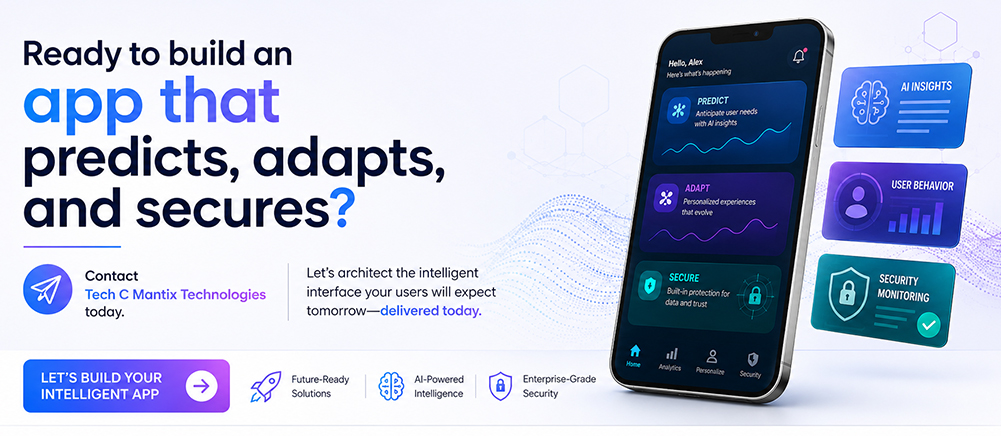
Ready to build an app that predicts, adapts, and secures?
Contact Tech C Mantix Technologies today. Let’s architect the intelligent interface your users will expect tomorrow—delivered today.