techccontdetaics Web Technologies April 17, 2026 65 7 minutes read

AI Debugging Isn’t Broken — Your Process Is

AI is helping engineering teams move faster than ever before. Tasks that once took weeks—planning, writing, testing, and deploying code—can now be completed in days, or even hours.

From code assistants to autonomous agents, AI is compressing development timelines at a speed we’ve never seen before.

On the surface, this looks like pure progress.

But underneath that speed, there’s a growing problem that many teams are starting to feel.

When something breaks, everything slows down.

Fixing issues is still time-consuming, frustrating, and often unpredictable.

The faster teams build, the more often they encounter problems—and when those problems appear, the process of debugging still feels stuck in the past.

This creates a strange imbalance: 

Development has evolved. Debugging hasn’t kept up.

The Real Issue

AI tools today are incredibly powerful at generating code.
They can produce clean, structured, production-ready-looking code in seconds. They follow patterns, apply best practices, and even handle edge cases surprisingly well.
But when that code fails, something interesting happens.
Developers don’t rely on AI to fix the issue.

Instead, they fall back on traditional debugging methods:

In other words, even though AI has transformed how code is written, it hasn’t transformed how problems are solved.

So AI didn’t eliminate debugging. It simply increased how often debugging is needed.

Because now, code is produced faster than ever—and with that speed comes more chances for things to break.

What’s Actually Going Wrong?

If you look closely at most engineering teams today, a clear pattern appears.

Teams are heavily investing in AI for code generation.

They are adopting tools that help them move faster, automate repetitive tasks, and reduce development time.

But at the same time, very few teams are investing in systems that help them understand, monitor, and debug AI-driven behavior.

This creates a major gap

Fast development. Slow understanding.

The tools being used are optimized for output. They are designed to create code—not to explain it.
So when something goes wrong, teams don’t have the visibility they need to quickly identify the issue.

They are left trying to figure out:

Without proper systems in place, this process becomes slow and inefficient.

And as AI usage increases, this gap only becomes more noticeable.

Why Debugging Feels Harder Now

There’s a common assumption that many teams make:

“If AI is writing the code, debugging should become easier.”

It sounds logical. After all, AI can follow patterns, reduce human error, and generate structured outputs.
But in reality, the opposite is happening.
AI is making systems more complex.

Here’s how:

More Code in Less Time

AI can generate large amounts of code quickly. This increases the overall size of the system, making it harder to track and understand.

AI-generated code often connects multiple services, APIs, and tools together. This creates deeper dependencies between different parts of the system.

Unlike traditional code, AI systems often involve hidden states—like prompts, context, or intermediate outputs. These are not always visible or easy to track.

AI doesn’t always produce the same output for the same input. Small changes in prompts or context can lead to very different results.
Because of all this, debugging becomes more difficult—not less.
Traditional debugging methods were designed for predictable systems. AI systems are not always predictable.
And that’s where the challenge begins.

Old Way vs New Reality

In traditional software development, debugging follows a clear and structured flow:

If something goes wrong, you can trace it step by step. You know where to look, what to check, and how to fix it.

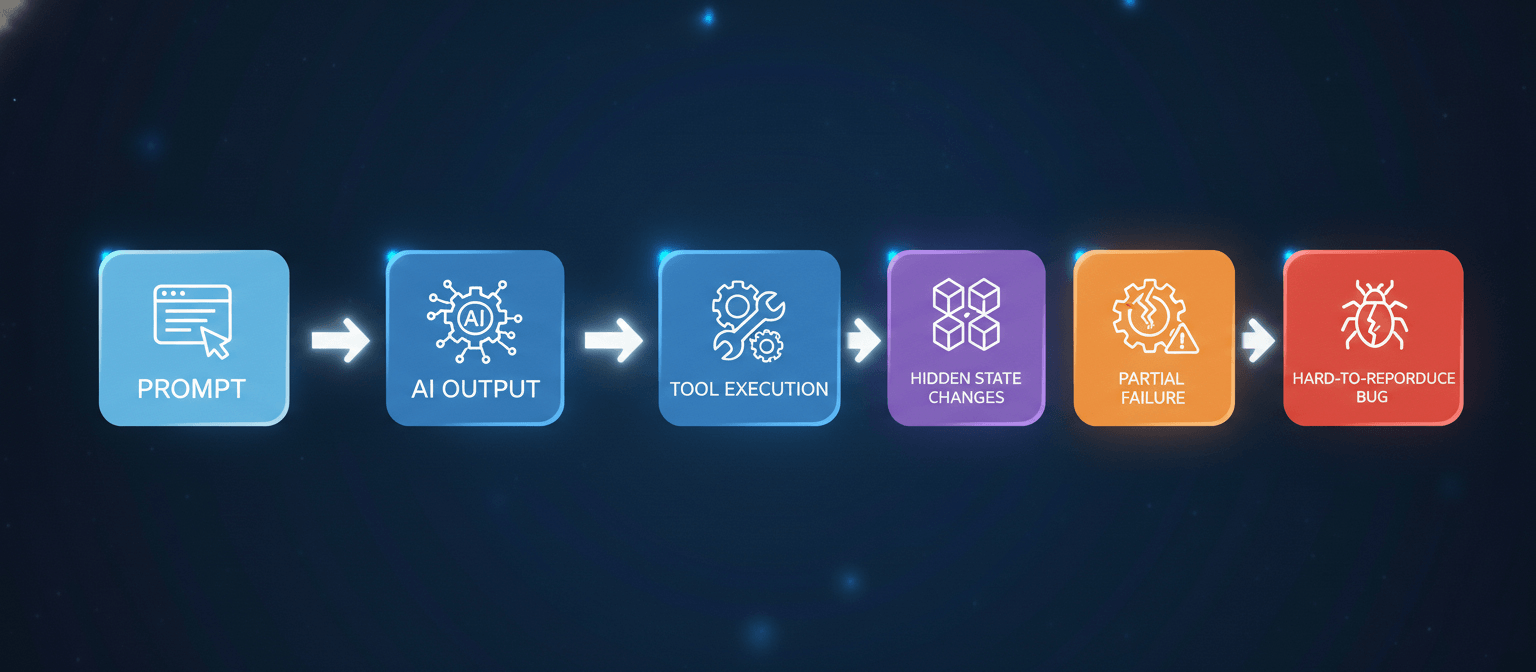
Now compare that to AI-driven systems:

This flow is far less predictable.
The problem is no longer just about fixing an error. It’s about understanding a chain of events that may not be fully visible.

Teams often face challenges like:

Not knowing what exactly happened inside the AI

Being unable to reproduce the issue consistently

Missing key context that led to the failure

Logs alone are no longer enough.

They show what happened at a surface level, but not the full story behind it.
As a result, debugging becomes less about analysis and more about guesswork.

What Smart Teams Are Doing Differently

While many teams struggle with this shift, some are adapting quickly

High-performing teams are changing how they approach development. They are not treating debugging as a separate step anymore.

Instead, they are designing systems where debugging is built in from the start.

This shift is often called moving from a traditional SDLC (Software Development Lifecycle) to an AI Development Lifecycle (ADLC).

In this approach, debugging is not reactive—it is proactive.

These teams build systems that include:

Better Visibility

Not just logs, but full visibility into how the system behaves. They track inputs, outputs, and interactions across the entire workflow.

Prompt Version Tracking

They keep track of which prompts were used and how they changed over time. This helps them understand what caused specific outputs.

AI Output Validation

They don’t assume AI outputs are always correct. They validate results using rules, tests, or evaluation pipelines.

End-to-End Tracing

They track how AI interacts with other systems, APIs, and tools. This helps identify where failures occur.

Continuous Monitoring

They monitor systems in real time and detect patterns in failures. This allows them to fix issues before they become major problems.
For these teams, debugging is not something they do after a problem appears.
It is something they prepare for in advance.

What We’re Seeing in Real Teams

Across the industry, several trends are becoming clear:

This tells us something important.

AI is not solving debugging challenges.

It is exposing them.

It is highlighting weaknesses in how systems are designed and how problems are handled.

Teams that ignore this will continue to face delays and inefficiencies.

Teams that address it will gain a strong advantage.

What Makes the Difference

The difference between struggling teams and successful teams is not AI adoption.

It’s how they think about the lifecycle.

The most effective teams:

They don’t wait for things to break. They build systems that make it easy to understand when and why things break.
For them, debugging is not an afterthought.
It is part of the architecture.

Final Thought

  • AI has not removed complexity from software development.
  • It has simply moved that complexity into new areas—areas that many teams are not yet equipped to handle.
  • The challenge is no longer just about writing code.
  • It’s about understanding systems that are dynamic, interconnected, and sometimes unpredictable.
  • If your team treats AI-generated code the same way it treats traditional code, you will face constant challenges.
    Because the rules have changed.
  • And unless your process changes with them, you’re not just debugging differently – You’re debugging blind.
Share: